

Built from lifts, not guesses
120+ exercises mapped to primary and supporting muscles, so a compound spreads credit the way it spreads work and an isolation movement lands directly.
Workout Body Map
iPhone Workout Tracker for Lifters
Your log knows every set you did. It just never shows you what they add up to.
Via Fortis Body Map turns logged lifts into muscle coverage across four time windows, from the last 7 days to the last 3 months, so you can see which muscles your training has actually been hitting and which ones went quiet.
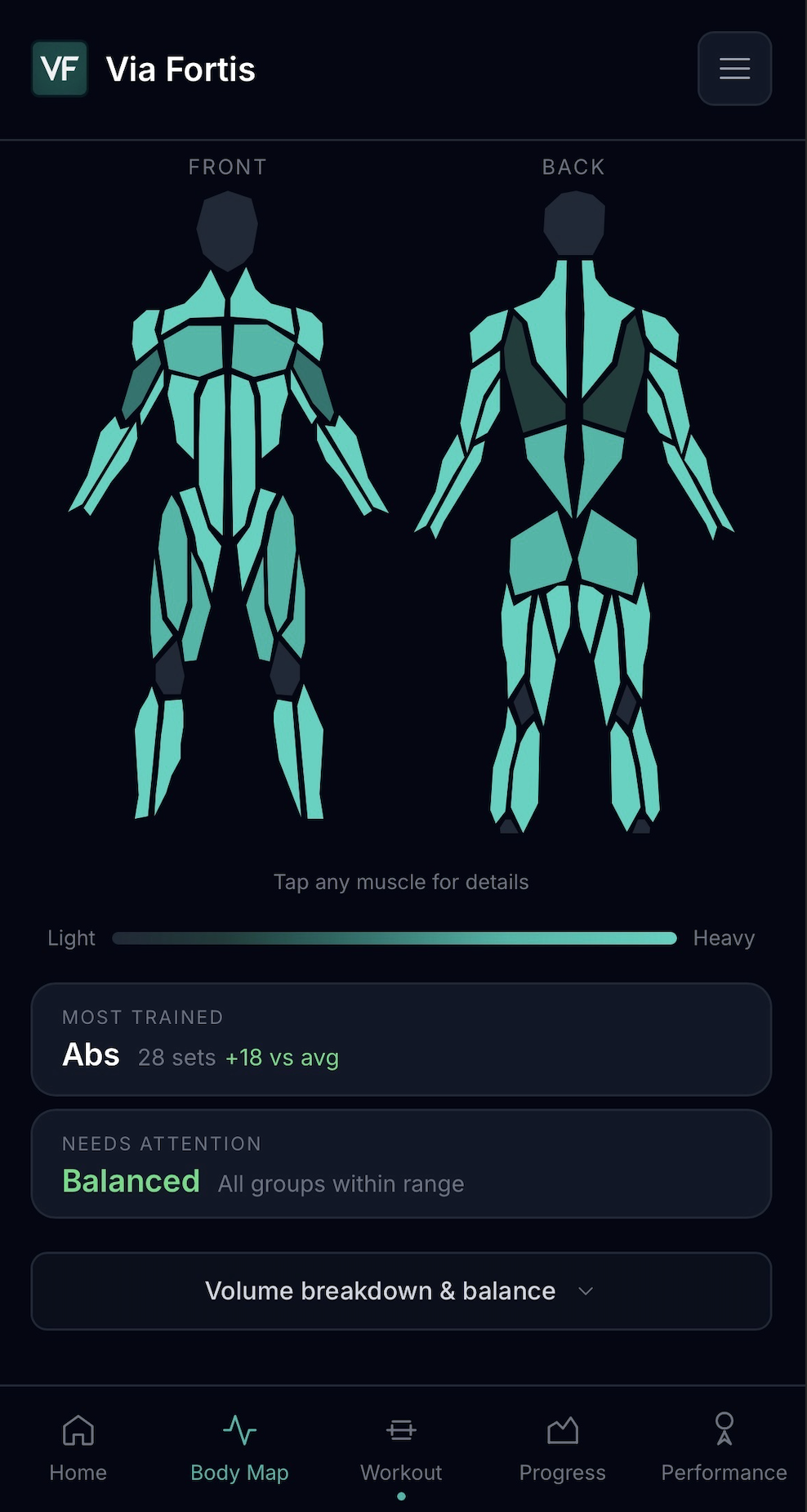
Your History, Mapped
A body map is only as useful as the stretch of history behind it. Move the window and watch the same training tell a different story.
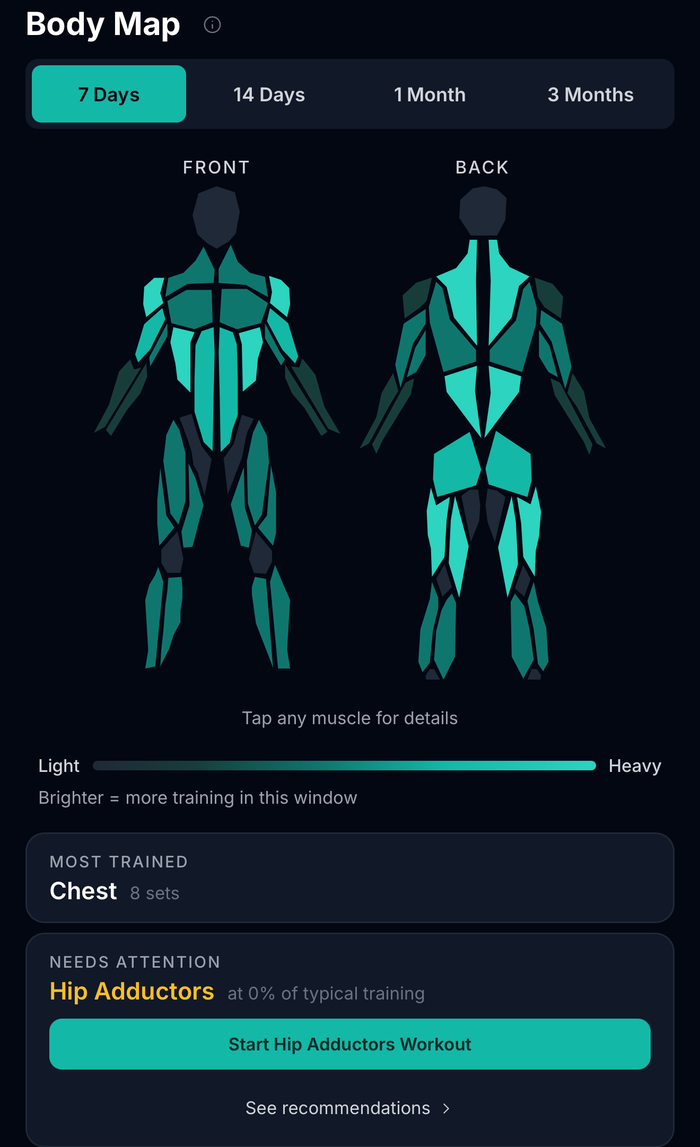
Chest leads at 8 sets, and hip adductors read 0% of typical training. A single week is a snapshot. That zero may just mean leg day has not come around yet.
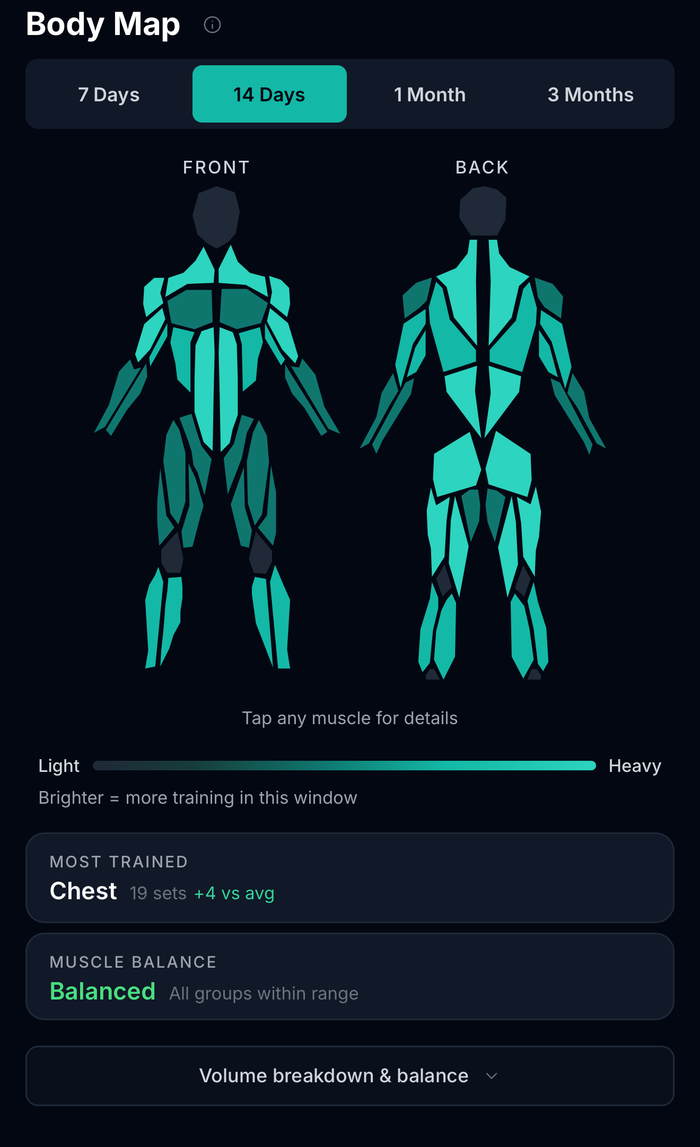
Now the map says Balanced, all groups within range, with chest four sets above its own average. A fortnight of history looks like a clean bill of health.
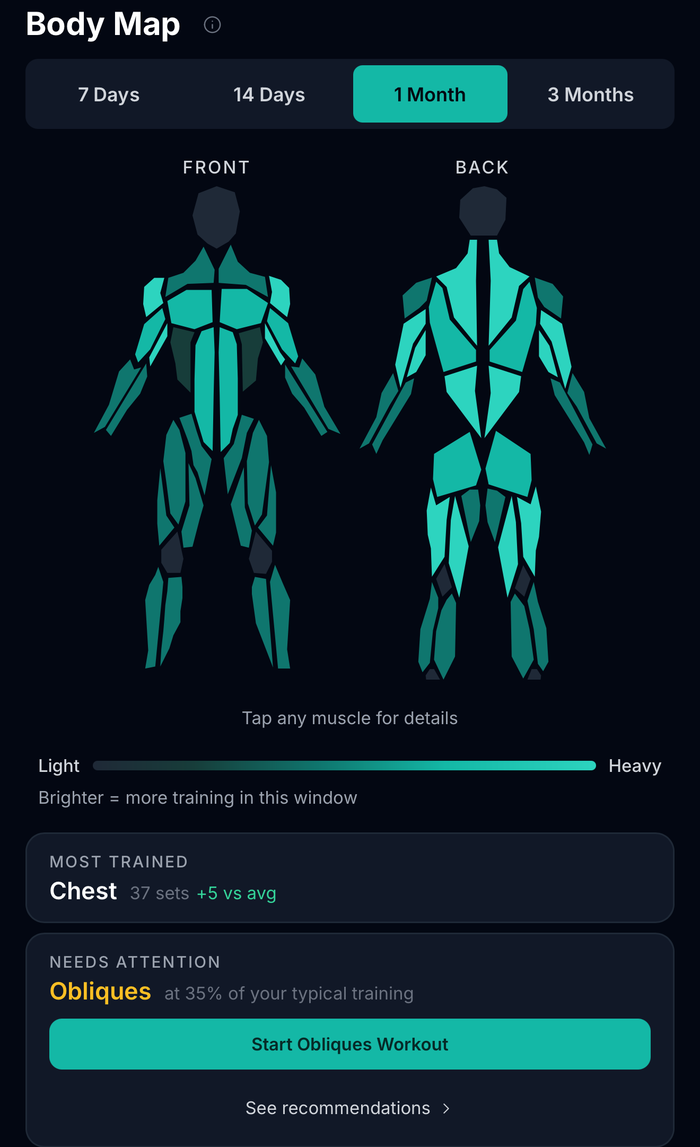
The balanced verdict disappears. Obliques surface at 35% of this lifter's typical training. Nothing changed in the gym between these two views. The window just got wide enough.
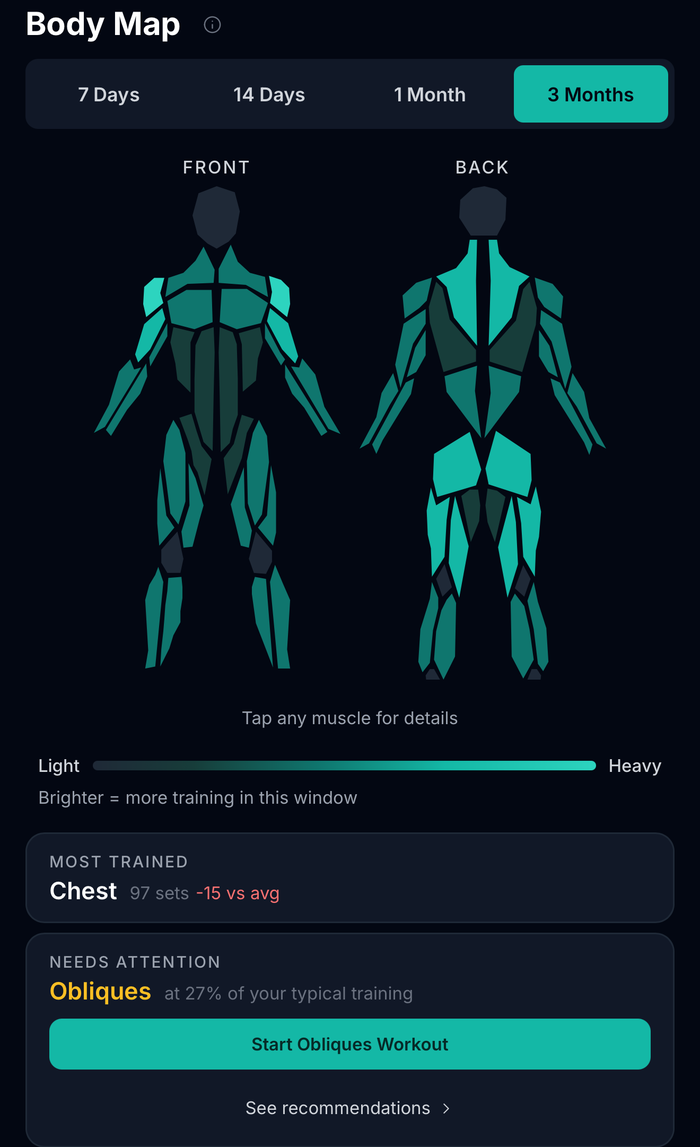
Obliques hold at 27% of typical across the quarter, and chest is 15 sets under its own average. This is the view that separates a bad week from a habit.
Every percentage is measured against this lifter's own history, not a generic target. Tap any muscle in the app for its recent sets, its trend, and a lift that would close the gap.
What It Is
A normal log records exercises, sets, reps and weight. It is a good record and a poor summary. A body map adds the layer on top: it maps every logged lift to the muscles that lift actually worked, then shades the body by how much work each one absorbed over the window you choose.
120+ exercises mapped to primary and supporting muscles, so a compound spreads credit the way it spreads work and an isolation movement lands directly.
Coverage is compared to your own previous 90 to 180 days, so the read means something whether you train 8 sets a week or 25.
7 days for what slipped recently. 3 months for the gaps that have been quietly there the whole time.
Reading The Map
A dim area is not automatically a problem. Rear delts and calves often look quiet because they are trained indirectly, and one light week inside a deliberate deload is doing exactly what it should.
What matters is whether the same area stays quiet as you widen the window. A gap that vanishes when you switch from 7 days to 1 month was noise. A gap that deepens across 3 months is your programming, and that is the one worth acting on.
That is why the map pairs with Weekly Balance, which reads the same log through movement patterns instead of muscles. When both views point at the same hole, you can stop wondering.
Related Tracking
See whether your week is balanced or quietly skewed.
Lift ProgressConnect logged workouts to visible progress.
ComparisonHow Via Fortis, Hevy, Strong and Fitbod handle muscle heat maps.
Sample AuditPreview how Via Fortis turns a normal log into muscle coverage and quiet gaps.
FAQ
A workout body map maps the lifts you logged to the muscles those lifts trained, then shades a body diagram by how much work each muscle absorbed over a chosen window. It turns a list of sets into a picture of coverage, so quiet areas become visible instead of staying buried in your history.
A log answers what you did. A body map answers what it added up to. The log knows you benched on Monday and rowed on Thursday. The map knows that across the last month your obliques got a third of your usual volume and your chest got more than its share.
Four windows: 7 days, 14 days, 1 month and 3 months. The 7 and 14 day windows are free. The longer two are part of Pro, and the 3 month window needs 90 days of logged history before it has enough to show.
Not on its own. Some muscles read quiet because they are trained indirectly, and a light week during a deload is working as intended. The signal to trust is persistence: if an area stays quiet as you widen from 7 days to 3 months, that is programming rather than noise.
Via Fortis maps 120+ exercises to primary and supporting muscles. A compound lift spreads credit across everything it works, while an isolation movement lands more directly. If you train something outside the catalog, you can add a custom lift and set its muscles yourself.
Some do. Hevy has a free tappable body diagram for the last 7 days or a chosen calendar week, Strong lists a muscle heat map among its features, and Fitbod shows a muscle recovery map based on fatigue rather than training history. The practical differences are how far back each looks and what the color is measured against. There is a full breakdown on our muscle heat map comparison.
Yes. The free training audit runs in your browser with no account. Enter your current program, a typical training week or your recent workouts and you will get a coverage read in about two minutes.
The app is iPhone only today. There is also a web app you can open in any browser, and the free training audit works anywhere without an account.
Run the free audit in your browser for a coverage read in about two minutes, or download Via Fortis on iPhone and let the map build from the workouts you log.